
Decoupled Architecture Explained: What Makes Headless CMS Different
As digital experiences become more ubiquitous across devices, formats and environments, organizations are turning toward a new architectural model that helps them scale without friction. Legacy content management systems were built for a web that no longer exists – one of single-channel websites and tightly coupled templates. The modern experience – driven by a fragmented multi-platform world – requires speed, flexibility and separation of content from delivery and presentation. Enter decoupled architecture. Headless CMS systems rely on decoupled architecture to transform how solutions are built, launched and maintained through an API-first delivery system. It’s important to know how decoupled architecture differs for organizations ready for the next generation of digital experiences.
Decoupled Architecture – Separation of Backend from Frontend
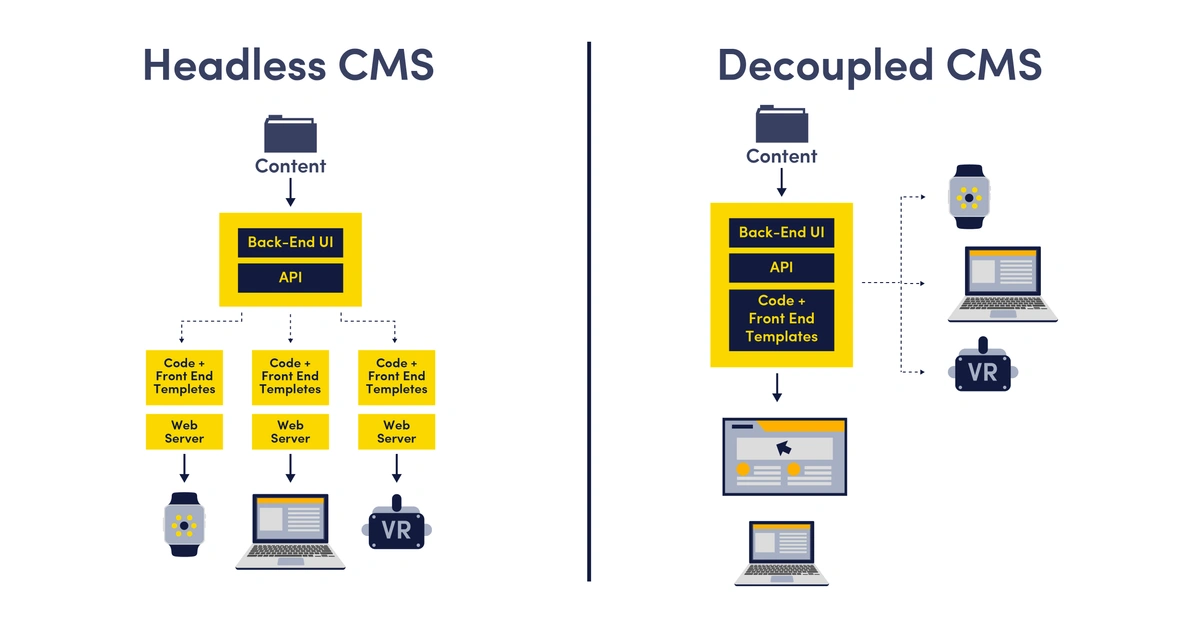
Decoupled architecture means no direct connection between the content repository on the backend and the presentation layer on the frontend. Unlike a traditional or monolithic CMS approach where you have templates, logic, and content in one environment decoupled architecture allows for independence. Information lives in one place (backend) where it is created, formatted and applied, and it’s merely sent to any device, framework, or interface via APIs. Headless CMS for scalable solutions fits directly into this model by enabling organizations to grow across channels without reworking their core content structure. This separation means creative and technical construction has less direct impact on each other, ultimately giving administrators, developers, and designers more flexibility in creating adaptable experiences as new environments emerge. Architecture that decouples enables a stable form of content that will remain and make sense as front-end technologies come and go, cycle through trends, and grow.
Removal of Traditional Template Orientation
CMS existed on a page-by-page model for many years, meaning each piece of content had a one-to-one presentation relationship. The more this model persisted over years, the more it became clear that organizations were limited to a single-page projection approach on user acquisition. In this digital age, users are using mobile apps, Internet of Things smart devices, digital kiosks and more, yet Headless CMS lets content go wherever it’s needed without duplicating work. There’s no template pre-built for an experience because there’s no presentation logic at the start. Instead, structured data is given via API for anything to appear wherever it might need a presence. This is a revolutionary consideration of operation or reconsideration of how systems operate. As reliance on the structure we know becomes removed, dependency on one linear analog for many channels becomes stripped.
API-Driven Delivery as the Defining Characteristic
Nothing defines headless CMS more than API-driven delivery. Instead of placing items in templates, templates are generated through an API with what any application, device or front-end framework needs to hear/see/consume. This facilitates rapid integration and process workflows that are easily deployable across omnichannel experiences. APIs are the connective tissue to the content available and the digital experiences built off its components. They create a fluid infrastructure that can adapt to anything that emerges in the marketplace. From wearable devices to VR interfaces, it doesn’t matter – as long as there’s an API to attach what’s needed. Delivery will always be universal regardless of where and for whom it’s projected/rendered/composed.
Performance and Stability Get Improved with Decoupled Architecture
Perhaps one of the most unnoticed advantages of having a decoupled infrastructure is performance. Since the front end and backend are separate, there are fewer resource silos operating at once. Instead, lightweight APIs deliver content while new front-end frameworks support rendering options through caching, static generation, or hydration. This means that speed is boosted, servers aren’t as taxed, and stability is improved through down times and overloads. Since people are updating one layer independently from the other, fewer organizations find themselves down for maintenance or facing unrecognized compatibility issues. Instead, they provide an expected performance that speaks to modern requirements for speed and stability.
Scaling for More Channels and Regions
As businesses expand their digital presence, channels grow and so does the complexity of having the right content in the right spaces at the right time. Decoupled architecture helps simplify this problem as content can be created once and delivered anywhere. One structured dataset can be dispersed among multiple websites, mobile applications, smart technology, kiosks, and anything else that might emerge along the way without duplication. For those who cater to international markets, this becomes even more useful. Variants and translations can be created from the same database for localized experience but brand consistency remains across regions. The ability to expand and scale in a smarter way is one of the most obvious reasons why headless CMS are the fabric of modern globalized digital worlds.
Developers Can Build However They Want with Modern Frameworks
With traditional systems, developers are often confined to pre-built themes, plugins or templating systems for faster access to usable and rendered content. This is no longer the case with decoupled architecture. Since the front end is its own entity, developers can build effectively in modern programs like React, Vue, Svelte or Next.js without concern for how it’s going to operate with the back end infrastructure. This means time to market is faster since digital teams can integrate best-in-class performance solutions, UI frameworks, and dev workflows that better produce engaging experiences with cleaner codebases. The concept of updating the front end’s technology and aesthetic without rebuilding the whole CMS ecosystem is one of the best technical advantages of a headless approach.
Confidence for Content Teams with Presentation-Agnostic Access
Just as headless architecture provides developers with a situational playground to operate off, it also unlocks an entirely new world for content teams. A decoupled system requires creators to focus more on templated fields than a presentation-heavy system would; this means vetted, easily accessible and aligned options for all involved without resizing for visual appeal or manipulating rendering sizes to omit web-friendly fonts; instead, it’s all about understanding, messaging and quality. The same can be said about aesthetic changes at the click of a button. Such capabilities also take time to train on and create inconsistencies across digital assets. No more oversized images, or blurry logos or smaller than anticipated hero headers. As companies grow, the need for this system in place grows with it as these pieces are iterated upon are beneficial time-ers with transparent systems that ease everyone in and maintain consistency across small and large libraries, alike.
Reduced Technical Debt and Simplified Systems Maintenance Over Time
The most unforeseen negative impact of a traditional CMS is technical debt. Over time, themes, plugins and updates become cumbersome. Increased instability, security threats and maintenance over time is not something any organization wants to face. Rather, a decoupled CMS naturally minimizes such risks as systems function independently of one another. The front end will never change based on a back end development. They exist in silos which create easier systems – and fewer conflicting elements – over time that support an organization that values security and much fewer redeployment hours than any would like to spare. Decoupled content management systems are a modularized dream that creates much cleaner systems that are easier to maintain long term.
In fact, successful organizations boasting stability over time, fewer redeployment hours and needs for systems over time boast an even further financial incentive to appreciating a headless CMS.
Supporting a Digital Ecosystem Ready for Evolutive Experiential and Technological Changes
The digital ecosystem is an ever-changing entity and new developments change how content may be approached down the line. It’s never an issue with a decoupled architecture as organizations never have to reinvent the wheel to stay relevant in the industry. From voice-controlled access to AI-created adventures, AR implementations to new wearables; a headless CMS can accommodate any progressive desire without losing anything already achieved or opening a digital Pandora’s Box that would take just as much time and energy to recapture if started over from scratch. Content that is templated and lives within an API boasts confidence in pre-existing components and proven material; trial and error becomes worthwhile with expansions and enhancements valuable to all involved. This is the ultimate form of future-proofing there is, and this is why headless architecture will be the next best thing through digital worlds.
Why Decoupled Architecture Is the Future for Modern Web Experiences
Decoupled architecture is the future because it encourages a different kind of approach to digital experience creation. It dismantles the rigidity that previously helped digital and content creators operate in the relative safety of a monolithic environment. With flexibility, scalability, and adjustability, headless CMS meets the needs of an ever-changing, multi-device world while simultaneously providing opportunity for growth for content creators and developers, drastically reducing technical debt, fostering better performance and responses and putting no cap on integration possibilities. As long as businesses are across different channels and as long as the web continues to develop diverse intersections, decoupled architecture will be a major contributor to the most transformative and sustainable experiences.
Increasing Security Over Static Content Requirements
Increased security comes from separation. With decoupled architecture, there are lower stakes for vulnerability being directly linked to front-end templates, content, and administrative options. In a single system, one hack gets people access to everything through one entry point. In a headless CMS, entry points are established with API request facilitation; each tier is separated, helping to create a naturally secure containerized experience. Developers can implement rate limits and authentication options to entry requests. Unless specifically given access, it’s that much more difficult for hackers to gain access from head-on exposure. Moreover, because front-end experiences do not rely upon plugins or server-side templates, they cannot be vulnerable thanks to third-party external exchanges. Separation creates a cleaner space that is more secure, especially when things operate in tandem over time.
Empowering Improved Workflows Across Teams and Departments
Decoupled architecture helps team work efforts as well. Developers don’t have to worry about stepping on designers’ toes or content creators’ webs when they’re developing front-end applications and vice versa; once a project has been established, each team can take their part without delay or dissatisfaction. For example, content teams can redress information without having to get approval from a developer first; developers can enhance front-end experiences without putting content at risk. This dynamic encourages speedier releases and less bottlenecking when companies have a lot of content to manage or running campaigns in perpetuity. Furthermore, agile methodologies become easier to utilize when each layer can evolve independently over time while simultaneously achieving safe collaboration. This contribution supports modern methodologies which encourage trial and error and open access to success.
Simplifying Multi-Brand, Multi-Site Ecosystems
For brands or companies with many different brands and/or sites to manage, a traditional CMS approach complicates life. Decoupled architecture simplifies it. Since it’s all one system but each digital property has its own way of presenting and experiencing content, structured content can easily be reused across brands and components that would be otherwise rendered separately do not have to be, avoiding redundancy. Updates can happen at the same time (or different times for different audiences) without having to recreate the wheel for each branded identity. Thus, the more a company acquires new brands or expands into new markets or starts new business units, the more scalable a headless CMS becomes. It maintains the integrity of a complicated ecosystem but allows for easy access and flexibility for rapid change.
Allowing for Constant Front-End Innovation
Finally, one of the best business reasons for the radical change of decoupled architecture is the constant front-end innovation it allows without any concern for backend costs. Developers can add various front-end frameworks, explore technologies still in their infancy, and redevelop UIs without needing to worry about the content hub permanently changing. Since it remains relatively stagnant, this creates an opportunity for constant innovation, constantly implemented better products, faster resolutions to feedback over time, and overall, an end-user experience that evolves and feels ever-up-to-date. Hence, digital properties no longer have to feel stagnant through backend accessibility issues; headless CMS ensures it’s fluidly part of the developmental process.